
We previously shared an article on what you can do in the event of a labor dispute, but again; prevention is better than cure! Especially when this leads to absenteeism, it becomes a complex situation. What do you do as an employer when there is an impending labor conflict? Whenever possible, you should try to find a solution together, before mediation or even litigation. But how do you go about that?
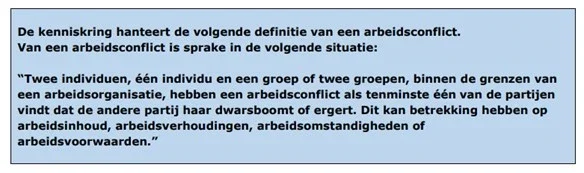
What is a labor dispute?
Below is the definition of a labor dispute. Therefore, if either party experiences it this way, it is already necessary to deal with it.
Joint interest in a labor dispute
How often does it happen in practice that both employee and employer have no confidence (anymore) in the outcome prior to the interview. If upon entering the room eye contact is already avoided and both parties sit at the table with their arms crossed, this is already a signal without anything substantive being said. Sin! On the contrary, it is important that both parties recognize the common interest and enter the conversation with an open attitude.
Tools when conflict is imminent
Do you want tools to start the conversation yourself? We would like to list three tools that you can use when a conflict is imminent. And if necessary, the Labor and Health Advisor can make preventive contact with mediators and coordinate which steps can be taken together first.
There are a number of options and tools here, namely:
Hurt
'Put the fish on the table, because underneath it will rot' says Dr. Kohlrieser. The goal is for both parties to bring out the hurts: these are the times when you as a person have experienced disappointments in the (working) relationship. It is necessary to have an inquisitive dialogue. Both parties should learn to see from the other that there have been events that have been experienced differently by both (without necessarily agreeing on the content). After taking stock, expectations can be expressed and agreements made with each other.
Escalation ladder of (Friedrich) Glasl
This tool shows the development of a conflict. Where is the conflict on the escalation ladder? Is there the will and commitment to work things out together? In the first phase there is still the will to restore and maintain the (working) relationship. This does not always require a mediator; colleagues may be able to resolve it together. In the second phase, an employee calling in sick due to a conflict can be an example, here it is more difficult to restore the working relationship. Together with a mediator, we can see if and how recovery is still possible. In the last phase we are talking about intense conflicts. Here lawyers may have been engaged and parties are no longer willing to talk to each other at the same table. The mediator can then mediate between the parties to reach an agreement to mutually end the working relationship.
Prevention is better than cure
Of course, the best way to prevent labor disputes is to continually have a good conversation with each other and express mutual expectations. Thus, sharing hurts should ideally be expressed in the moment, rather than mapping them out afterwards.
The mediation parties involved add that it is important for employers to pick up signals from employees and then step up to the proper conversation. "A good investment and we see that there are gains to be made here. If that happens escalation can possibly be prevented" said Margriet (Dit Perspectief), Daniëlla (DAAN mediation) and Ilona (Mediatonland).
Would you like to prevent escalation and address impending labor disputes preventively? Do not hesitate to contact the Labor and Health Advisor. From De Arbodienst we use the STECR guideline in case of a (threatening) labor conflict.